


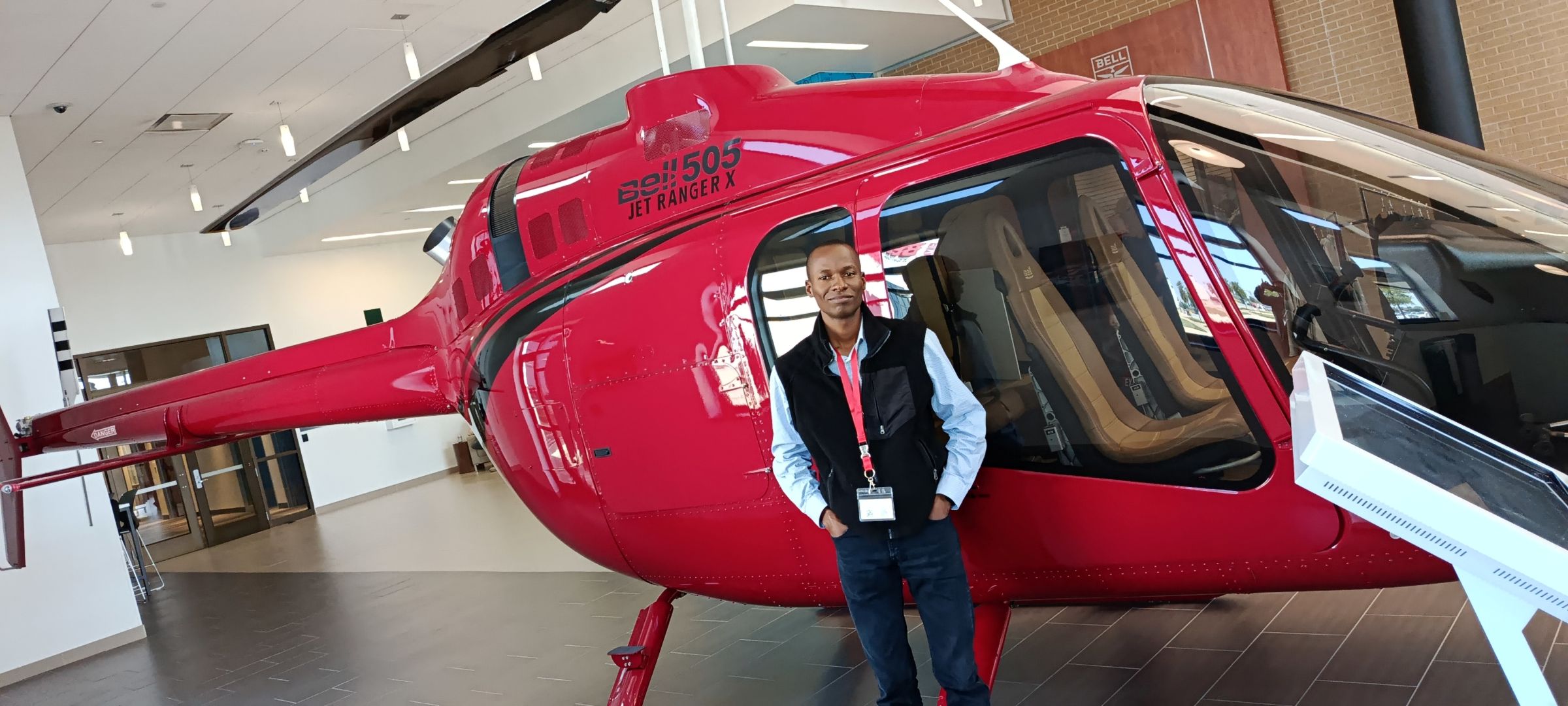
Sunday Sanusi, recipient of the 2026 Robinson Pete Riedl AMT Scholarship, is the head of maintenance at the Central Avionics Overhaul and Calibration Centre in Kaduna, Nigeria.
VAI scholarship recipient Sunday Sanusi hopes to establish his own MRO shop
Discover how VAI scholarship recipients have turned opportunity into achievement—and how you can do the same—in this exclusive VAI Weekly series.
The VAI scholarship program is back for 2027, with scholarships available for students, professional aviation mechanics/engineers, and commercial helicopter pilots.
A benefit exclusively for VAI members, the scholarships help vertical aviation pilots, mechanics, engineers, and aspiring professionals cover the costs of their education and training. Not a VAI member? Join the association and enjoy access to the VAI scholarship program as well as a host of additional educational, safety, and other benefits. Applications for a 2027 VAI scholarship award must be received by 11:59 pm eastern time (UTC-5) on Dec. 4, 2026.
During this scholarship season, VAI Weekly is highlighting past VAI scholarship winners in an exclusive series of articles. In this installment, we hear from Sunday Sanusi, recipient of the 2026 Robinson Pete Riedl AMT Scholarship. Sunday, who is the head of maintenance at the Central Avionics Overhaul and Calibration Centre in Kaduna, Nigeria, tells us what fascinates him about helicopter maintenance, how his VAI scholarship will help him obtain a Robinson helicopter type rating, and more.
VAI Weekly: What inspires you about working in the vertical aviation community?
Sunday Sanusi: What inspires me most about vertical aviation is the combination of engineering complexity, operational versatility, and the unique capabilities of rotorcraft. Helicopters can operate in environments and perform missions that conventional aircraft cannot, making them indispensable for transportation, emergency response, security, rescue, and many other applications. I’m particularly fascinated by the engineering challenges involved in maintaining these machines and ensuring that their performance, reliability, and safety are consistently preserved.
How will your VAI scholarship help you meet your educational goals?
This scholarship will enable me to advance my technical knowledge of and practical experience in helicopter maintenance. In particular, it will support my goal of obtaining a Robinson helicopter type rating, giving me deeper platform-specific knowledge and strengthening my competence as a rotorcraft maintenance professional. The training will complement my existing engineering and maintenance experience and provide a stronger foundation for my long-term development in vertical aviation.
What are your professional goals for the next three to five years? What are your long-term career goals?
Over the next three to five years, I intend to continue developing my expertise in helicopter maintenance while gaining additional experience and professional certifications. I want to become highly proficient in the maintenance of rotorcraft platforms and gradually take on greater technical and leadership responsibilities. In the long term, my ambition is to establish and lead a reputable helicopter MRO [maintenance, repair, and overhaul] organization that provides reliable, professional, and internationally recognized maintenance services while also developing skilled aviation professionals.
What would be your dream job in aviation?
My dream job would be to serve as the CEO of a world-class aircraft MRO organization specializing in rotorcraft. I’d like to combine my engineering and maintenance experience with leadership and business management to build an organization known for technical excellence, safety, integrity, and the development of competent aviation professionals.
Who is your greatest inspiration in the industry and why? In what ways has this person helped you?
My greatest inspiration is Igor Sikorsky, whose pioneering work transformed the possibilities of vertical flight. What inspires me most about him was his ability to pursue an idea that many considered difficult and turn it into practical reality. His approach has influenced the way I think about engineering problems: to look beyond conventional solutions, ask deeper questions, and consider possibilities from different perspectives. His legacy reminds me that innovation often begins with the courage to explore what hasn’t yet been achieved and think outside the box.
What do you see as the biggest challenge facing the vertical aviation industry?
The major challenge facing vertical aviation is the availability and affordability of aircraft rotables and replacement components, particularly for older helicopter fleets. Supply-chain limitations, long lead times, and increasing component costs can make it difficult and expensive to keep aging rotorcraft operational. Addressing this challenge will require stronger component support networks, improved repair and overhaul capabilities, and greater investment in local MRO capacity. Developing these capabilities can improve fleet sustainability while reducing dependence on distant suppliers.


